
Describe the run
Approximate length in metres or kilometres, what you are containing, the number of gateways you need and roughly where the block sits.
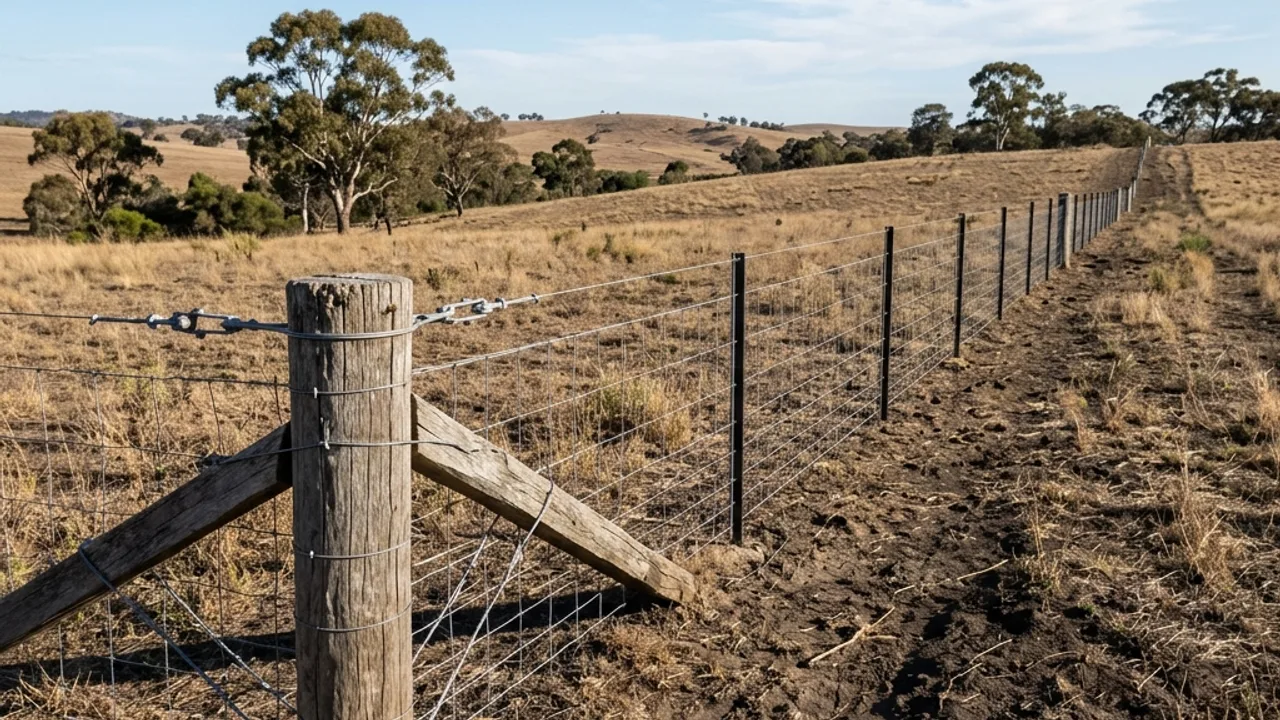
Stock fencing priced by the kilometre rather than the metre. A rural run fails at the ends, which is why the strainers, the stays and what actually holds the animals you run matter more than the wire in the middle.
You have taken on acreage or a lifestyle block at Highfields, Cotswold Hills or Westbrook, or out across the Downs country toward Oakey and Pittsworth, and the existing boundary is sagging wire on posts that gave up years ago. You want stock held, dogs contained and an entrance that looks like something from the road. You probably already know the vocabulary, so the detail below is about how the run is built rather than what the terms mean. What it does spend time on is where rural runs fail, how the ends are anchored, and where Queensland licensing sits for rural work as opposed to suburban work, because the answer is genuinely different. Send the approximate run length in metres or kilometres, what you are running, and where the block is.
Prefabricated woven mesh strained between posts, with spacing and height chosen for the animal being contained rather than for a standard roll.
A timber or steel post-and-rail entrance where the driveway meets the road, built to carry the gate and to look like the front door of the property.
Offset live wires to stop cattle leaning on a new run or to keep horses off the mesh, energised from mains or solar depending on where the run sits.
Heavy anchored end posts with diagonal stays at ends, corners and every change of direction. These carry the tension of the whole run and are where cheap fencing shows up first.
Farm gate widths set from what actually has to get through, from a ute and float to a tractor and implement, not from the narrowest gate on the shelf.
Where a run crosses a gully or a wash, the line needs floodgates, additional anchoring or a deliberate detour. It is decided walking the line, not off a satellite image.
Match the mesh to the animal and the rest gets easier. Cattle push and lean, so height and a strong top wire matter more than tight bottom spacing, and an offset electric line stops them leaning at all. Sheep and goats find gaps, so aperture size low down is the deciding factor. Horses need something that will not trap a hoof, which rules some mesh patterns out entirely and often argues for post-and-rail or a hinge-joint with an electric offset. Dogs are their own problem, usually solved at the bottom of the fence rather than the top.
Then the part that actually determines whether the run lasts: the ends. A rural fence does not fail in the middle of a span, it fails when a strainer post pulls in, the tension drops out of the wire and a kilometre of mesh goes slack. Strainer assemblies at ends, corners and changes of direction have to be anchored to carry the full tension of the run, with stays doing the work of resisting the pull. Post spacing and star picket intervals between them hold the line and stop the mesh bellying, but they do not substitute for a properly built end.
Cost is genuinely per kilometre and genuinely variable. What moves it: how much clearing the line needs, how many corners and therefore how many strainer assemblies, mesh type and height, the number and width of gateways, whether gullies or washouts complicate the line, and how the ground digs. Nobody can give you a rate over the phone that means anything, which is why the run gets walked before a figure is written down.
The ground changes what a run costs and how it is built, and it changes within a short drive. Out on the black-soil plains west of the range the clay is highly reactive: it swells wet and shrinks dry, and it heaves posts across those cycles, which pulls tension out of a strained run without a storm being involved. Up on the range the red basalt soils drain better but are rocky to dig, so the digging is slower and harder while the posts sit more stably once they are in. A Highfields block and a Westbrook paddock are two different jobs.
Now the licensing point, stated accurately because it is often stated wrongly. It is not true that all fencing work in Queensland requires a QBCC licence. A fence with no concrete footing, made of posts, pickets or stakes joined by strands of wire, is exempt from QBCC licensing at any value, which covers a great deal of ordinary rural fencing. A fence on agricultural or pastoral land is exempt regardless of its value. Outside those exemptions, on residential land, work valued at $3,300 or more including labour and materials needs a licensed contractor.
That is a statement of where the law draws its lines, not a workaround. Licensed operators do the work that requires a licence, and where an exemption genuinely applies, it applies. One more distinction worth knowing on pastoral land: the standard for a sufficient dividing fence there is not a 1.8 m suburban fence, it is whatever restrains the livestock actually being grazed, which is a far more sensible test for a boundary running through a paddock.
Approximate length in metres or kilometres, what you are containing, the number of gateways you need and roughly where the block sits.
Corners counted, gullies and washouts noted, clearing assessed, digging conditions checked, and gateway positions set against how machinery actually moves on the place.
Mesh type and height, post and picket spacing, strainer assemblies counted individually, gateways by width, and any electric offset priced as its own line.
Strainer assemblies and stays go in and cure, the line posts and pickets follow, then the mesh is strained and tied off to the anchored ends.
Strainer assemblies and stays are specified for the tension the run will actually carry and the soil they are anchored in. That is the single item that decides whether a fence is still tight in five years or slack in two, so it is where the detail goes.
The wire-fence and rural-land exemptions are real and they are explained as they are written, not glossed over to make a job sound more regulated than it is. Licensed operators handle the work that requires a licence.
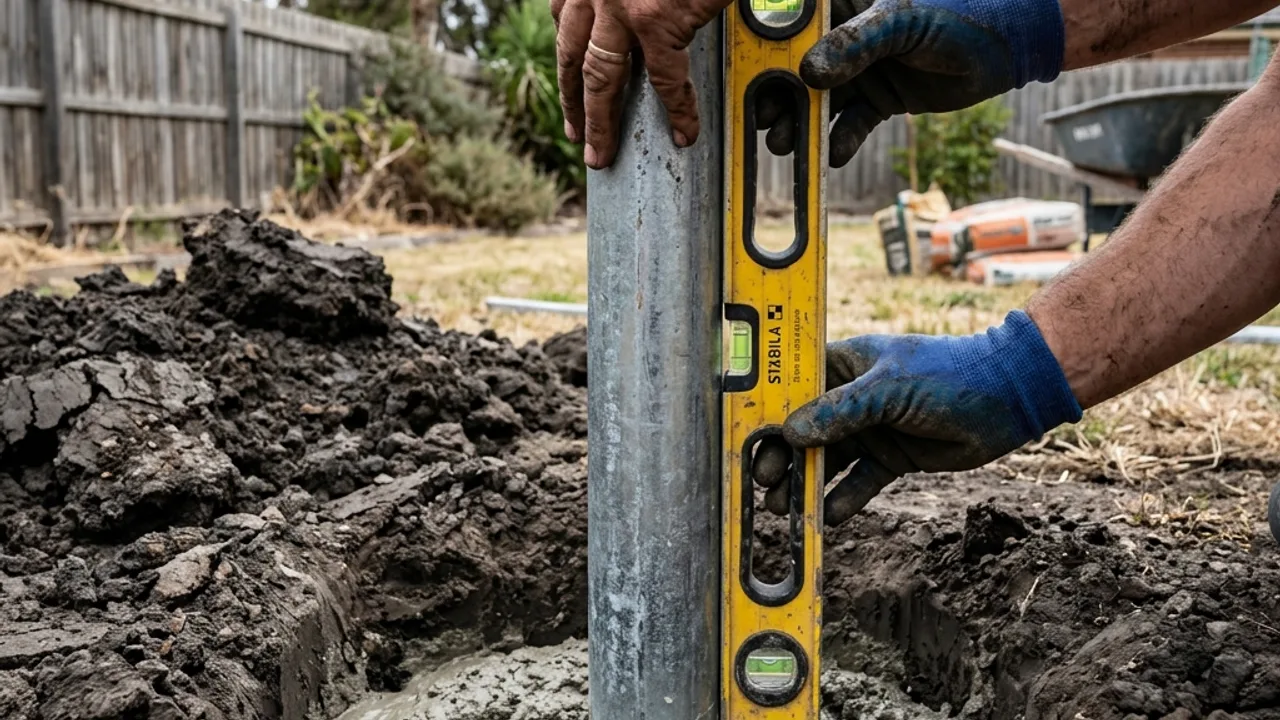
Reactive black soil and rocky red basalt need different footing approaches and different amounts of time in the ground. Knowing which one your line crosses before pricing is why the figure holds once the auger is turning.
Mesh spacing and height are matched to the animal and the ends are anchored to hold tension, which is how containment is achieved. No stock-proof or escape-proof guarantee is offered, because animals, gates left open and falling trees are not things a fence specification controls.
It depends on clearing, terrain, the number of corners and strainer assemblies, mesh type, gateway count and how the ground digs. A fixed rate quoted before the line is walked is a guess. Walk it first, then the figure means something.
A wire fence with no concrete footings is exempt from QBCC licensing regardless of value, and a fence on agricultural or pastoral land is exempt regardless of its value. Beyond those exemptions the $3,300 threshold applies. The honest answer depends on what is being built and where.
That is almost always the ends rather than the middle: an under-anchored strainer that pulled in, or posts that heaved through a wet-dry cycle on reactive clay. Both are addressed at the design stage by anchoring and footing for the actual soil.
Questions Toowoomba homeowners bring to this job, answered plainly.
Pick your suburb for the local block, soil and access notes, or send the form and we will come back with a written quote for rural fencing.
Talk to a Toowoomba fencing specialist
Got a boundary run that no longer holds?
Send the run length, what you are containing and where the block is. Someone walks the line, counts the corners and comes back with a written quote by section.